


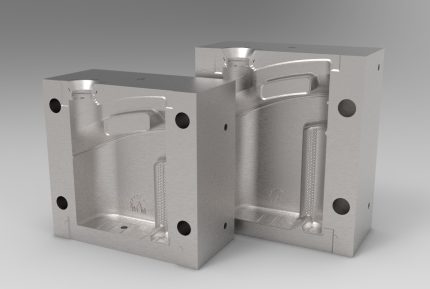
High-precision Injection molding for producing complex plastic parts with excellent dimensional accuracy and durability. Ideal for a wide range of industrial applications.
Injection molding
Injection molding is a process in which a thermoplastic polymer is heated above its melting point, transforming the solid polymer into a molten fluid with relatively low viscosity. This molten material is then mechanically pressurized and injected into a mold shaped according to the desired final product. This method is ideal for producing plastic parts with complex geometries and various dimensions.
Injection Molding Process Steps
An injection molding process includes preparing a pressurized, flowable material source, a pressurized fluid source, and a mold assembly that can move from an open position to a closed one. The mold assembly consists of first and second mold sections that together form a fully sealed cavity, an inflatable core positioned inside the sealed cavity and secured to the first mold section, a pressurized fluid channel connecting the fluid source to the inflatable core, and a flowable material channel that guides the pressurized material into the cavity.
The pressurized fluid is introduced into the inflatable core at a primary pressure level, causing the core to expand and form a defined core boundary. The flowable material is then injected—at a pressure lower than the primary fluid pressure—into the space defined by the cavity and the core boundary.
Once the injected material solidifies, the pressurized fluid is released from the inflated core, the mold opens, and the solidified part is ejected from the mold assembly.